

Special Needs Trust: What is it and why is it important?
July 28, 2021
Schools are back in session and it's time to remember to protect children with special needs year-round and for life.

Before you know it the bell will ring and schools will be back in session. It’s the time of year when we start thinking about our children.
But have you created a plan to protect your child with special needs year-round??
If you are the parents of a child with special needs or thinking of leaving an inheritance to someone with special needs, we encourage you to carefully craft a special needs trust as part of their estate plan.
A special needs trust in California is a legal arrangement that allows a person with a physical or mental impairment to still receive funding designated by state assistance programs without losing their eligibility.
Trusts are designed to protect a person with supplement benefits should their financial circumstances change in the future.
Let us work with you to answer all of your questions about the terms of the trust and why it’s important.
Trusts must be established before a beneficiary turns 65.
These trusts, if properly written, can benefit the recipient while preserving their eligibility for social security and Medicaid.
Make an appointment today and see how we can help you -- Taking the Next Steps Together.
A special needs trust in California is a legal arrangement that allows a person with a physical or mental impairment to still receive funding designated by state assistance programs without losing their eligibility.
Trusts are designed to protect a person with supplement benefits should their financial circumstances change in the future.
Let us work with you to answer all of your questions about the terms of the trust and why it’s important.
Trusts must be established before a beneficiary turns 65.
These trusts, if properly written, can benefit the recipient while preserving their eligibility for social security and Medicaid.
Make an appointment today and see how we can help you -- Taking the Next Steps Together.

By Marc Sigmon
•
December 27, 2025
Over the last 10 years, I have worked in the Medicare industry and experienced a wide range of challenges alongside my clients. From navigating the COVID-19 pandemic, to contract changes involving Scripps Coastal and Scripps Clinic Medical Groups, rising healthcare costs, physician group affiliation changes, and increasing prescription drug prices—one constant has remained true: education and regular policy reviews are essential to understanding Medicare . Medicare is not a “set it and forget it” program. Coverage options, provider networks, prescription drug formularies, and plan availability can change from year to year. Staying informed is often the difference between avoiding unexpected disruptions and facing unnecessary costs or limitations in care. Underwriting and Preexisting Conditions One of the most misunderstood aspects of Medicare involves underwriting and preexisting conditions. Many people assume Medicare functions like employer-sponsored insurance, but the rules can be very different. When someone first becomes eligible for Medicare, there are protected enrollment periods during which medical underwriting does not apply. Outside of those windows, underwriting may come into play depending on the type of coverage being considered. This is especially important for individuals currently enrolled in a Medicare Advantage plan who later wish to move to a Medicare Supplement. In most cases, medical questions are required, and a carrier may approve the application, charge a higher premium, or decline coverage altogether based on health history. Timing matters. Before applying for coverage that requires underwriting, individuals should explore whether a protected enrollment opportunity exists. What Are Special Enrollment Periods? A common question I hear is: “What are Special Enrollment Periods, and do they apply to me?” Special Enrollment Periods (SEPs) allow Medicare beneficiaries to make changes outside of standard enrollment windows due to qualifying life events. In some cases, insurance carriers may also offer a guaranteed issue period—sometimes referred to as an underwriting holiday—allowing plan changes without medical underwriting. If a guaranteed issue opportunity is not available, certain life events may still trigger an SEP. For example, moving to an area where a current plan is no longer available can open a Special Enrollment Period and allow changes without underwriting. Understanding whether an SEP applies before making coverage decisions is critical. Plan Discontinuations and Coverage Changes In 2025, looking ahead to the 2026 plan year, a number of PPO Medicare Advantage plans were discontinued. When this occurs, individuals are typically given the opportunity to select another Medicare Advantage plan. If no action is taken, they are disenrolled and returned to Original Medicare (Parts A and B). While this ensures continued coverage, it can create gaps if prescription drug coverage or supplemental coverage is not reviewed in advance. These changes highlight why annual reviews are so important, even for individuals who have been satisfied with their coverage in the past. You’re Not Always Locked In During client meetings, I often encounter hesitation because people worry they will be locked into a plan for the entire year. Fortunately, that is not always the case. The Medicare Advantage Open Enrollment Period runs from January 1 through March 31 each year. This allows individuals already enrolled in a Medicare Advantage plan to make a one-time change if something unforeseen occurs. I often refer to this as the “OOPS period”—a safety net for those who discover early in the year that their plan is not the right fit due to provider access, prescription coverage, or out-of-pocket costs. Medicare and Our Veterans Finally, and just as importantly, these considerations apply to veterans who are Medicare-eligible . In recent years, carriers have developed Medicare Advantage plans designed to coordinate with Tricare for Life, Veterans Administration benefits, and CHAMPVA . These plans often do not include prescription drug coverage, allowing veterans to continue using their existing drug benefits through the VA or other qualifying coverage. For veterans who are not eligible for dental, vision, or hearing benefits through the VA, Medicare Advantage plans may offer access to these services, along with additional benefits such as over-the-counter allowances, gym memberships, wellness programs, and in some cases, a Medicare Part B premium giveback. Enrollment for these veteran-focused plans is available year-round. Final Thoughts Medicare can be complex, and the rules continue to evolve. Education, planning, and regular policy reviews remain the most effective tools for making informed decisions. Whether someone is new to Medicare or has been enrolled for years, taking the time to understand available options can help ensure coverage continues to meet healthcare needs. About the Author Marc Sigmon, MBA, is the founder of the Marc Sigmon Insurance Agency, a veteran-owned agency based in Fallbrook. He has worked in the Medicare and health insurance field for over a decade, helping individuals, families, and veterans understand their coverage options. Marc is a two-time recipient of the NAIFA Quality Award (2024 and 2025) for Health Insurance and Employee Benefits, a graduate of the BBB Empower by GoDaddy Accelerator , and was recognized as a 2025 Veteran Leaders of Influence by the San Diego Business Journal. He is actively involved in the community through veteran advocacy, small-business support, and health-insurance education initiatives throughout North County San Diego. New Paragraph

June 1, 2022
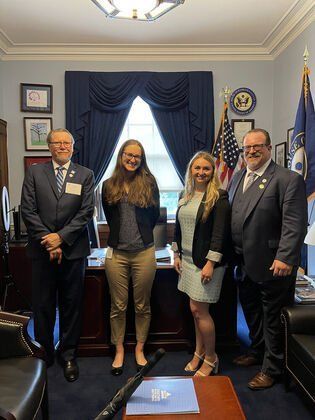
Marc Sigmon, far right, visits the legislative office of Congressman Mike Levin (CA-49) with, from left, Mike Wilbanks, a NY Life agent; Alison Feinswog, Levin's legislative assistant; and Lauren Crumbaker, another NY Life agent. (courtesy Village News)
Marc Sigmon, agent/CEO of Marc Sigmon Insurance Agency, spent three days in Washington, D.C., as part of the National Association of Insurance and Financial Advisors Congressional Conference. The congressional conference, held May 23-24, was to build or establish relationships with local advisors and agents within each district to address critical issues now and into the future.